


-
Pre-Oxidized Fiber Fabric in Industrial Heat Shield and Furnace Insulation Applications
-
How PANOX pre-oxidized fiber fabric performs in industrial heat shields, furnace curtains, expansion joints, molten splash protection and high-temperature filtration, and how to select the right construction for your process temperature.
Why Pre-Oxidized Fiber Fabric Works Where Other Textiles Fail
Pre-oxidized fiber fabric is a flame retardant textile made from PANOX pre-oxidized polyacrylonitrile fiber, a material that does not melt, does not drip and will not sustain combustion in air. In industrial heat shield and furnace insulation applications, that combination matters more than any single headline number.
Most textile insulation fails in one of three ways. It melts and collapses against a hot surface, it burns through under a splash of molten metal, or it loses its tensile strength after weeks of continuous heat exposure. Pre-oxidized fiber fabric addresses all three, which is why plant engineers specify it for heat shields, furnace curtains, expansion joint covers and thermal gaskets.
This article explains how pre-oxidized fiber fabric behaves in real industrial heat insulation work, where it outperforms glass fiber and aramid, and how to select the right weight and construction for your process temperature.
What Pre-Oxidized Fiber Fabric Actually Is
Pre-oxidized fiber, also called pre-oxidized PAN or PANOX, is produced by heating polyacrylonitrile precursor fiber in air at 200 to 300 degrees Celsius. The oxidation reaction cross-links the polymer chains and forms a thermally stable ladder structure. The fiber turns black, becomes infusible, and gains its flame retardant character before any carbonization step.
The result is a fiber with a limiting oxygen index above 40 percent, which means it needs an oxygen-rich atmosphere to burn at all. Under normal plant conditions it simply chars. It does not melt, so it holds its physical shape when a burner flame or a splash of molten metal hits it.
Shanghai Tanchain supplies pre-oxidized fiber in several forms, including filament tow, staple fiber, spun yarn, woven fabric, felt and non-woven mat. For heat shield and furnace insulation work, the woven fabric and the needle-punched felt are the two most common formats.
Key Properties That Matter in Furnace and Heat Shield Service
Continuous Service Temperature and Short-Term Peaks
Pre-oxidized fiber fabric performs continuously at temperatures up to about 250 degrees Celsius in air and tolerates short-term exposure well above that. It does not have the absolute ceiling of a ceramic textile, so it is not the answer for a 1000 degree furnace lining. It is the right answer where the hot face is paired with a refractory brick, a ceramic blanket or a ceramic paper barrier.
This layered approach is standard practice. The ceramic layer holds the peak temperature, while the pre-oxidized fiber fabric provides the mechanical support, the thermal break and the flexible outer skin that survives thermal cycling.
Non-Melting and Non-Dripping Behavior
When exposed to a direct flame, pre-oxidized fiber fabric chars and forms a carbonaceous surface layer. It does not shrink away, it does not produce molten polymer droplets and it does not create a secondary fire hazard on the plant floor.
This is the property that separates pre-oxidized PAN fabric from polyester, polypropylene and nylon insulation textiles, all of which melt and drip. It is also the reason the material is preferred for molten splash protection and for welding blankets.
Low Thermal Conductivity and Stable Loft
Pre-oxidized fiber felt has a low thermal conductivity and maintains its loft under compression and vibration. In furnace door seals and expansion joint covers, the felt keeps its thickness and therefore its insulating value after many heating and cooling cycles.
Woven pre-oxidized fiber fabric, by contrast, delivers mechanical strength and abrasion resistance. The two are frequently combined in one assembly: felt for the insulation core, fabric for the protective skin.
Chemical and Moisture Resistance
Pre-oxidized fiber is resistant to most organic solvents, oils and mild acids. It is not recommended for strong alkalis or for long-term exposure to high-humidity acidic atmospheres. In those cases a coating or a laminated construction helps.
The fiber is also electrically non-conductive, which allows it to be used near electrical equipment and in electrical insulation applications where a conductive carbon fiber would be unacceptable.
Where Pre-Oxidized Fiber Fabric Is Used in Industry
Industrial Heat Shields and Thermal Barriers
A heat shield made from pre-oxidized fiber fabric is used to protect cables, hydraulic lines, sensors and control cabinets from radiant heat. In steel mills, foundries and glass plants, these shields sit close to the heat source and must survive vibration, dust and occasional contact with hot material.
Because the fabric does not melt or drip, a damaged heat shield never introduces a new ignition source. This is a decisive advantage over cheaper polymer-based thermal barriers.
Furnace Curtains and Door Seals
Furnace curtains made from pre-oxidized fiber fabric reduce heat loss when a furnace door opens during charging or inspection. The curtain remains flexible after repeated thermal cycling, so it continues to seal against the door frame instead of cracking like a rigid board.
Expansion joint covers follow the same logic. A furnace shell grows and contracts with each cycle, and a rigid seal fails within months. A pre-oxidized fiber fabric cover moves with the joint and keeps the insulating pack in place.
Molten Splash Protection and Welding Blankets
In foundries and die casting shops, pre-oxidized fiber fabric is used as a splash curtain and as a protective blanket over equipment. The fabric chars on contact with molten metal and continues to act as a barrier rather than burning through.
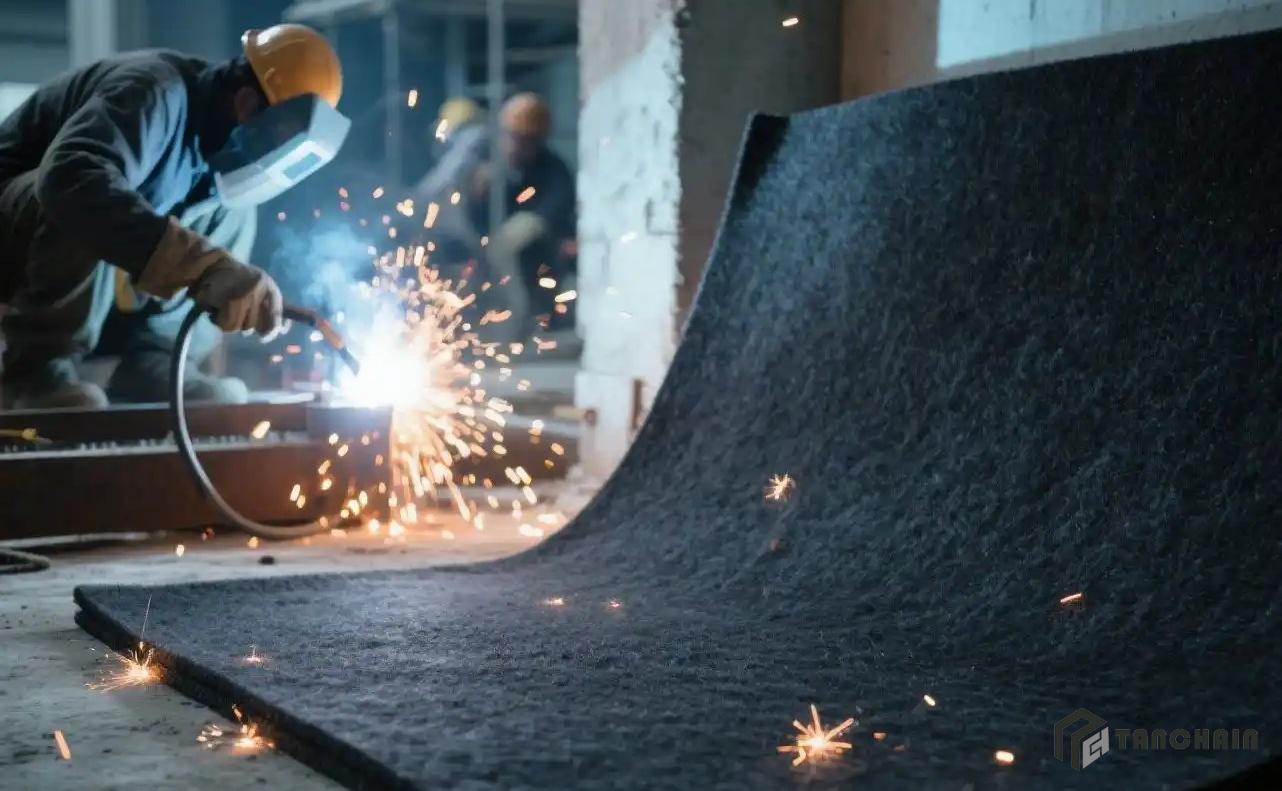
Welding and cutting operations use the same material as a fire blanket. It resists sparks, slag and spatter, and it can be reused after a charred section is trimmed away.
Thermal Gaskets and Sealing Elements
Pre-oxidized fiber fabric is often laminated with a coating, a foil facing or a silicone layer to produce thermal gaskets with controlled compressibility. These gaskets seal flanges, ducts and exhaust systems where a rubber gasket would harden or burn.
High-Temperature Filtration and Insulation Supports
Pre-oxidized fiber needled felt is widely used as a high temperature filter medium and as the insulating support layer behind a filtration membrane. In cement kilns, incinerators and asphalt plants, the felt handles dust-laden gas streams at temperatures that would destroy a polyester filter bag within days.
Because the fiber is non-melting and dimensionally stable, the filter bag keeps its shape and its filtration efficiency across the full temperature range of the process.
Battery and New Energy Equipment Insulation
Pre-oxidized fiber fabric is increasingly specified as a thermal runaway barrier in battery packs and as insulation around high-temperature process equipment in new energy manufacturing lines. It provides an electrically insulating, flame retardant barrier that does not melt during a thermal event.
How to Choose the Right Pre-Oxidized Fiber Fabric
Match the Construction to the Duty
Woven plain weave fabric gives the best abrasion resistance and is the default choice for heat shields, curtains and blankets. Twill weave offers greater drape and conforms better to curved surfaces. Needle-punched felt is preferred where the primary requirement is thermal conductivity rather than mechanical strength.
Select Weight by Radiant Heat Load
Heavier fabrics resist radiant heat and mechanical abuse more effectively but are less flexible. A typical heat shield uses a fabric in the 200 to 600 gram per square meter range. Furnace curtains and splash blankets usually sit at the heavier end of that range.
Consider Coatings and Laminates
Aluminum foil lamination reflects radiant heat and improves the surface emissivity of a heat shield. Silicone or polyurethane coating adds water resistance and abrasion resistance. Aluminized or vermiculite coatings raise the short-term temperature ceiling.
Choose the coating based on the dominant threat. A radiant heat application benefits from a reflective foil facing, while an abrasion application benefits from a tough polymer coating.
Confirm the Temperature Margin
Always compare the continuous service temperature of the chosen construction against the actual hot face temperature, including process upsets. Where the peak exceeds the capability of the fabric, add a ceramic paper or ceramic blanket as the primary barrier and use the pre-oxidized fiber as the mechanical support and outer skin.
Comparison with Alternative High-Temperature Fibers
Pre-Oxidized Fiber vs Glass Fiber
Glass fiber is cheaper and handles higher continuous temperatures, but it is brittle and loses strength when flexed repeatedly. Pre-oxidized fiber fabric stays flexible and is far more resistant to vibration and handling damage, which lowers maintenance cost in mobile or vibrating equipment.
Pre-Oxidized Fiber vs Aramid
Aramid fiber offers higher tensile strength and better cut resistance. Pre-oxidized fiber wins on heat and flame behavior. Aramid degrades faster at elevated temperature and is more sensitive to UV exposure, while pre-oxidized fiber is inherently flame retardant without any added finish.
Pre-Oxidized Fiber vs Carbon Fiber
Carbon fiber is stronger and stiffer, but it is electrically conductive and oxidizes at elevated temperature in air. Pre-oxidized fiber is electrically insulating, flame retardant and thermally stable, making it the better choice for insulation and fire protection, while carbon fiber remains the choice for structural reinforcement.
Installation and Maintenance Notes
Pre-oxidized fiber fabric is normally cut with a hot knife or heavy-duty shears to prevent edge fraying. Edges should be bound, folded or coated where the fabric will see abrasion. Fasteners, grommets and wire ties should be rated for the same service temperature as the fabric.
Handle the fabric with gloves. Like all high-performance fibers, pre-oxidized fiber can cause skin irritation from broken filament ends before it is fully encapsulated.
For maintenance, inspect the fabric for charred or thinned areas and replace or patch them. Because the material does not propagate flame, a localized char does not compromise the rest of the shield. This allows partial refurbishment instead of a full replacement, which lowers total cost of ownership.
Conclusion
Pre-oxidized fiber fabric delivers a rare combination for industrial heat shield and furnace insulation duty: it does not melt, it does not drip, it does not sustain combustion and it keeps its mechanical integrity through repeated thermal cycling. Where a plant needs a flexible, electrically insulating barrier that survives heat and molten splash without adding fuel to a fire, this is a material worth evaluating.
Shanghai Tanchain manufactures pre-oxidized fiber tow, staple fiber, spun yarn, woven fabric, needled felt and finished thermal products for industrial insulation applications. To review specifications or request a quote, browse our pre-oxidized fiber fabric product range or contact our technical team for a construction recommendation based on your process temperature and heat load.