


-
Carbon Fiber Tube and Plate Solutions for UAV and Drone Airframe Manufacturing
-
Carbon fiber tubes, plates, prepreg and fabric solutions for UAV and drone airframes - how high specific stiffness, vibration damping and low thermal expansion solve real airframe engineering problems.
Carbon Fiber Tube and Plate Solutions for UAV and Drone Airframe Manufacturing
Unmanned aerial vehicles live or die by two numbers: flight time and payload capacity. Both are governed by the same physical constraint, and airframe weight is the lever that moves it. For engineers building multi-rotor, fixed-wing and hybrid UAV platforms, carbon fiber tubes, plates and machined profiles have become the default structural answer because they deliver metal-grade stiffness at roughly one quarter of the density. This solution guide walks through the real engineering problems UAV builders face and how a proper carbon fiber material package solves them — from boom and arm design through to flight-test stability.
1. Why UAV Airframes Cannot Stay in Aluminum and Plastic
Early consumer drones were built from injection-molded plastic and aluminum alloy. That worked when payloads were small and flight time expectations were modest. It stops working the moment you add gimbal cameras, LiDAR, spraying tanks or long-range telemetry, because every additional gram of airframe competes directly with battery mass and sensor payload.
2. The Core Engineering Problems
Before choosing materials, it helps to name the problems precisely. UAV airframe designers consistently report the same five.
Structural weight. Multi-rotor arms and fixed-wing spars carry bending and torsional loads, yet must stay light enough for a useful payload.
Vibration and resonance. Motor rotation and propeller imbalance feed vibration into the frame, degrading camera footage and stressing solder joints on flight controllers.
Thermal drift. Arms exposed to direct sun or motor heat expand, shifting alignment on precision-mounted sensors.
Environmental exposure. Salt spray on maritime drones, humidity in agricultural spraying, and UV on long-endurance platforms all attack unprotected structures.
Repeatable assembly. Airframe builders need parts that arrive dimensionally consistent so that arms, motor mounts and landing gear align without hand-fitting.
3. Matching Carbon Fiber Products to Airframe Sub-Systems
A UAV is not one structure — it is a set of sub-systems with different load paths. The carbon fiber product family maps onto those sub-systems cleanly.
3.1 Arms, Booms and Spars — Carbon Fiber Tubes
Carbon fiber tubes are the workhorse of multi-rotor arms and fixed-wing spars. Wound and roll-wrapped tubes offer high specific bending stiffness, meaning a given tube diameter carries more load at lower mass than an aluminum equivalent. Our carbon fiber tubes are supplied in outer diameters from 5 mm to 450 mm with wall thicknesses of 1 mm to 5 mm, allowing the arm stiffness to be tuned to the motor/propeller combination rather than accepted as a fixed catalogue value.
For folding-arm designs, telescoping and square profiles let the operator collapse the platform for transport while keeping the structural joint rigid in flight.
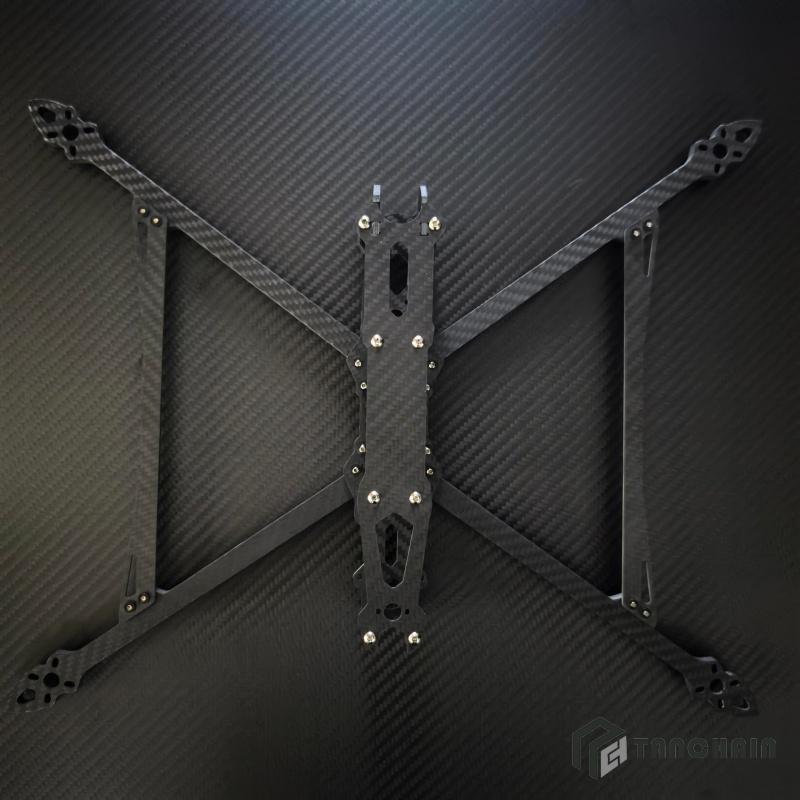
3.2 Frame Plates, Battery Trays and Motor Mounts — Carbon Fiber Plates
Flat carbon fiber laminated plates form the central frame, the battery deck and the motor mount plates. Unidirectional and woven laminates are selected according to the stress direction: woven 3K sheet for general frame plates that must resist multi-directional loads, and unidirectional laminates where stiffness must run along a single dominant axis. Plates are available in the common 1 mm to 10 mm range, with 5 mm CFRP laminate a frequent choice for central frame decks where mounting hardware must be countersunk.
3.3 Landing Gear and Sensor Brackets — Machined Profiles
Landing gear legs and camera brackets need localized cut-outs, slots and fixing points. Because carbon fiber plate machines cleanly with carbide tooling, complex bracket geometry can be produced directly from laminate rather than assembled from multiple metal parts — reducing fastener count and eliminating a common source of looseness after repeated landings.
3.4 Nose Cones, Fairings and Payload Housings — Prepreg and Fabric
Aerodynamic fairings, sensor housings and payload pods benefit from carbon fiber prepreg, where the resin content is controlled at the supplier stage for consistent fiber volume fraction and low void content. Prepreg lay-up gives smooth surfaces, low thermal expansion and repeatable part-to-part thickness — valuable when a housing must seal against moisture or align an optical sensor.
4. The Technical Case: What Carbon Fiber Actually Delivers
The advantages are not marketing claims; they follow from measured material properties.
4.1 Specific Strength and Specific Stiffness
Carbon fiber composites reach density in the region of 1.55–1.7 g/cm³, against approximately 2.7 g/cm³ for aluminum and 7.8 g/cm³ for steel. Combined with high tensile modulus, this produces a specific stiffness several times that of aluminum, which is the property that directly translates into longer flight time or heavier payload.
4.2 Vibration Damping
Polymer-matrix composites dissipate vibration energy internally rather than transmitting it as freely as metal. In practice this means cleaner image stabilisation, less fatigue loading on electronic assemblies, and reduced screw loosening on airframes that see hundreds of flight cycles.
4.3 Low Thermal Expansion
Carbon fiber laminates exhibit low coefficients of thermal expansion, particularly in the fiber direction. For surveying and mapping drones carrying precision optics, this keeps sensor geometry stable between a cold morning launch and a warm afternoon flight.
4.4 Corrosion and Chemical Resistance
The carbon fiber/epoxy matrix system does not rust and resists the salt-laden air typical of maritime patrol and coastal survey missions, an environment where aluminum airframes require protective coating maintenance.
5. Material Selection Matrix for UAV Builders
The following table summarises how common UAV sub-systems map to carbon fiber products and selection priorities.
| Sub-system | Recommended Product | Primary Selection Priority |
|---|---|---|
| Multi-rotor arms / booms | Carbon fiber tubes, round or square | Bending stiffness to mass; joint rigidity |
| Central frame deck | Carbon fiber plates, woven laminate | Multi-directional strength; machinability |
| Fixed-wing spar | Carbon fiber tubes (large diameter) | Bending and torsional stiffness |
| Motor mounts | Unidirectional carbon plate | Local stiffness; thermal stability |
| Payload pods and fairings | Carbon fiber prepreg / fabric | Surface finish; low void content |
| Landing gear and brackets | Machined carbon fiber plate | Complex geometry; fastener durability |
6. Implementation Notes: Getting the Material Right
Choosing carbon fiber is the easy decision. Choosing it correctly is where projects succeed or fail, and these are the practical points we raise with UAV customers during specification.
6.1 Match Fiber Direction to Load Path
Composite stiffness is directional by nature. An arm that bends along its length needs fibers running axially; a plate loaded in two axes needs a woven or multi-directional lay-up. Specifying the wrong orientation produces a part that is simultaneously heavy and weak.
6.2 Consider Galvanic Isolation at Metal Interfaces
Where carbon fiber contacts aluminum or steel fasteners, electrically insulating washers, bushings or a thin isolating layer prevent galvanic corrosion in humid or marine environments. This is a small design detail with a large durability consequence.
6.3 Design Joints Deliberately
Carbon fiber laminates are strong in-plane but sensitive to point loading and crushing at bolted joints. Bonded sleeves, local thickening at mounting points, or dedicated insert designs keep the load distributed rather than concentrated on a few bolt holes.
6.4 Verify Dimensional Consistency Across Batches
Airframe assembly line efficiency depends on parts that fit the same way every time. Tube concentricity, wall uniformity and plate thickness tolerance should be agreed as acceptance criteria up front rather than discovered during assembly.
7. Supporting Materials in the Same Platform
UAV construction rarely uses carbon fiber in isolation, and a single supplier for the full textile package simplifies procurement and quality control.
Aramid fabric and yarn for ballistic and impact-tolerant housings, battery protection and anti-abrasion skid surfaces.
Pre-oxidized fiber felt and fabric for thermal barriers around battery compartments and ESC bays, providing flame retardant and temperature insulation protection.
Carbon fiber fabric for repair lay-ups, local reinforcement and prototype panels built by wet lay-up or vacuum bagging.
8. Why Work With Tanchain
Shanghai Tanchain New Material Technology supplies carbon fiber tubes, plates, prepreg, fabric and finished carbon fiber products alongside aramid and pre-oxidized fiber materials, giving UAV manufacturers a single source for the structural and protective textile content of an airframe platform. Products are produced under a controlled quality management system, from raw material intake through to finished part inspection, and dimensions are agreed against customer drawings before production rather than after.
In short, a well-specified carbon fiber material package turns airframe weight from a design constraint into a competitive advantage — more payload, longer endurance and a structure that survives the mission profile it was designed for.
Ready to specify carbon fiber tubes, plates or prepreg for your next UAV platform? Browse our carbon fiber product range or contact our team to discuss dimensions, lay-up and delivery for your airframe program.