


-
Carbon Fiber in Metallurgical Furnace Equipment: Fixtures, Charging Systems and Heat Shielding
-
Carbon fiber composite fixtures, plates, tubes and pre-oxidized fiber heat shielding for metallurgical furnaces - low thermal expansion, high specific stiffness and non-combustible barriers for furnace engineering.
Carbon Fiber in Metallurgical Furnace Equipment: Fixtures, Charging Systems and Heat Shielding
Metallurgical furnace equipment sits at the harshest intersection of heat, load and atmosphere in heavy industry. Continuous casting lines, annealing and hardening furnaces, sintering furnaces and heat treatment cells all need fixtures and handling hardware that hold their shape while glowing hot, resist thermal shock on repeated cycling, and keep tight tolerances across a campaign that may run for months. Carbon fiber composites and high-temperature carbon products are taking over that role — from carbon fiber furnace fixtures and charging frames to radiant heat shielding and pre-oxidized fiber insulation — because they solve problems that steel and ceramic hardware cannot.
Shanghai Tanchain New Material Technology manufactures the full carbon and aramid family used in this sector: carbon fiber precursor, carbon fiber filament and staple fiber, carbon fiber fabric, carbon fiber prepreg, carbon fiber composite parts, plates and tubes, aramid filament and staple fiber, aramid fabric, and pre-oxidized fiber tow, filament, staple fiber, yarn, fabric and felt. This article looks at where those materials earn their place in metallurgical furnace operations and what buyers should evaluate before specifying them.
Why Carbon Fiber Fits Furnace Engineering
The engineering problem in a furnace is rarely "survive the hottest temperature." It is "stay accurate and serviceable through thousands of heating and cooling cycles." Carbon fiber reinforced polymer parts deliver that for structural and handling hardware outside the hottest zone, while carbon and pre-oxidized fiber products cover shielding and insulation duties closer to the heat.
Low thermal expansion, high dimensional stability
Carbon fiber laminates show an extremely low coefficient of thermal expansion, close to specialty ceramics in the fiber direction. A fixture built from carbon fiber plate does not lengthen and shorten with every cycle the way a steel jig does, so alignment between the fixture and a slab, or between a fixture and a measuring datum, stays predictable over the whole campaign.
High specific stiffness for moving loads
Charging and transfer structures must carry metal at temperature. Because carbon fiber composite delivers high stiffness at roughly a quarter of the density of steel, a charging frame or roller assembly can move faster on lower drive power. On a line that runs continuously, lower moving mass means lower energy cost per cycle and less wear on bearings, guides and drive trains.
Resistance to thermal shock and creep
Furnace hardware fails not only from peak temperature but from the gradients of loading and unloading. Steel jigs creep and distort slowly. Carbon composite parts, designed with a suitable resin system or carbon-carbon treatment, hold their geometry through repeated cycling far better than mild steel equivalents within their design window.
Non-magnetic and electrically neutral behavior
Induction heating, electromagnetic stirring and furnace instrumentation depend on clean magnetic fields. Carbon fiber fixture plates and tooling are non-magnetic, so they do not disturb eddy current patterns or interfere with thermocouple and sensor placement the way steel hardware can.
Where Carbon Fiber Is Used in Furnace and Foundry Operations
Charging frames, jigs and fixture plates
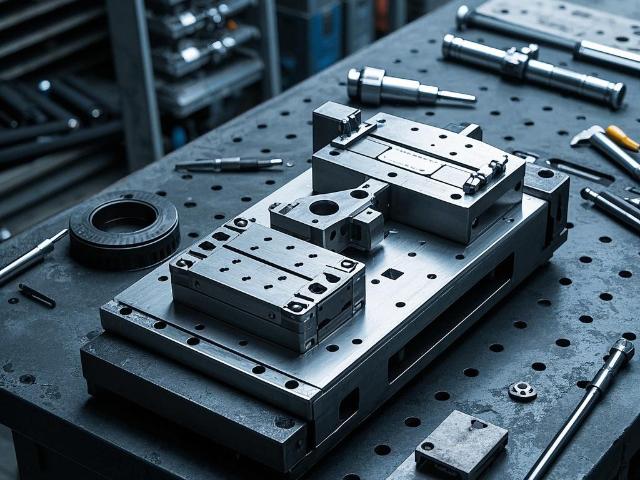
The most common entry point is the fixture that holds workpieces through heat treatment. Carbon fiber plates and machined composite fixtures replace steel banding jigs and ceramic fixtures on hardening and tempering lines. They hold a batch in position through quench and cooling without the bowing and permanent set that steel jigs develop, and because the composite is light, operators can reposition a fixture manually to cut changeover time betw