


-
Carbon Fiber in the Welding and Metal Fabrication Industry: Equipment, Tooling and Repair
-
How carbon fiber composites, aramid fabric and pre-oxidized fiber are used across the welding and metal fabrication industry - lightweight welding robot arms, fume extraction booms, positioners, fixtures, friction stir welding tooling, thermal barriers, pipeline weld reinforcement and battery pack fabrication.
Welding and metal fabrication sit at the foundation of almost every manufactured product, from a pressure vessel headed for a chemical plant to the chassis of an electric bus. Carbon fiber composites have moved into this sector quietly but steadily. They are not replacing welded steel structures. Instead, they are solving a narrower and very practical set of problems: making positioning and handling equipment lighter, keeping heat away from sensitive parts, closing the gap between welding automation and the structures it joins, and repairing weld defects without shutting a plant down. This article maps where carbon fiber and related high performance fibers are already used across the welding and fabrication industry, which material forms suit each job, and what buyers should check before specifying a composite part.
Why the Welding and Fabrication Industry Uses Carbon Fiber
Welding shops live with three constraints that carbon fiber answers unusually well: moving mass, thermal management, and corrosion.
The first is momentum. Every kilogram on a welding gantry, a fume extraction arm, a torch manipulator, or a positioner has to be accelerated and stopped hundreds of times a day. Reducing that mass improves cycle time, reduces motor and gearbox wear, and allows lighter structures without losing stiffness.
The second is heat. Welding processes concentrate energy in a small zone, and the equipment around that zone often needs to be thermally inert, electrically insulating, or both. Aramid fabric, pre-oxidized fiber felt, and in some cases carbon laminates serve as barriers, standoffs, and protective layers where a metal part would conduct heat into something it should not touch.
The third is the environment. Fabrication shops are full of moisture, spatter, pickling acids, and cleaning solvents. Carbon fiber composites do not rust, which makes them attractive for fixtures and handling equipment that spend years in that atmosphere.
Carbon Fiber in Welding Robots and Torch Manipulators
Robotic welding cells are where carbon fiber composites have made the clearest inroads. A traditional welding robot carries a heavy upper arm, and the payload left for the torch, the collision sensor, and the cable package is limited by the mass of the arm itself. Every kilogram removed from the arm can be spent on a longer reach, a heavier torch package, or a faster acceleration profile.
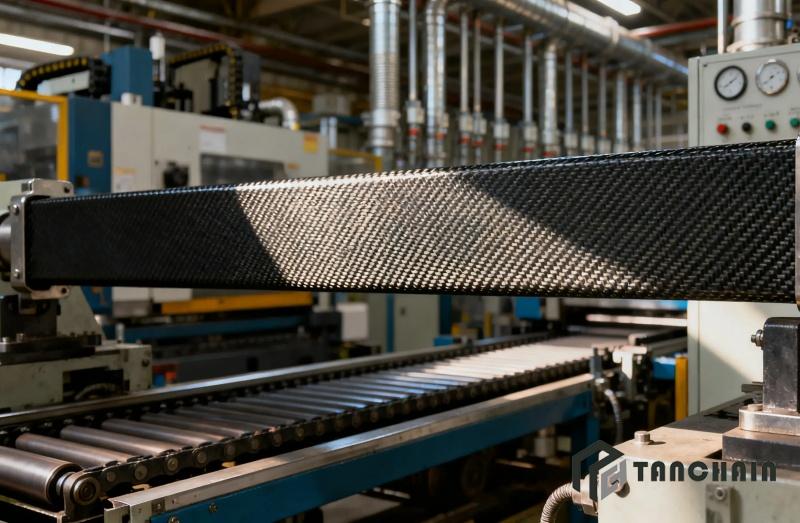
Carbon fiber tubes and pultruded profiles are now common in the arm sections of collaborative welding robots and in the boom structures of gantry mounted torch manipulators. The stiffness matters as much as the weight. A welding torch must hold its position within a fraction of a millimetre while the arm accelerates and reverses. Carbon fiber reinforced polymer delivers high specific stiffness, so the arm resists bending and vibration without the mass penalty of an aluminium or steel design.
Vibration behaviour is the second reason. Welding motion is stop-start by nature, and a flexible arm rings after every direction change. Carbon fiber composites have better internal damping than metals of comparable stiffness, which shortens settling time and improves seam tracking on thin material.
Composite Booms for Welding Fume Extraction Arms
Welding fume extraction is a health and safety requirement in most industrial markets, and the extraction arm is a piece of equipment that the operator physically moves dozens of times per shift. A heavy steel arm gets parked in one position and left there; a light arm gets repositioned close to the arc, where it actually captures the fume.
This is why several fume extraction manufacturers have moved to lightweight carbon composite booms and articulated arm segments. The composite tube carries the extraction duct, the counterbalance load, and the joint loads at the same time, and it does it at a fraction of the weight of the steel equivalent. Because the arm also has to hold position without sagging, stiffness is again the critical property, not just low mass.
Carbon fiber tubes are a natural fit for this application. They can be produced in long lengths with consistent wall thickness, they can be bonded or mechanically fastened into the joint housings, and they do not corrode in the humid, chemically aggressive atmosphere of a fabrication shop.
Welding Positioners, Rotators, and Handling Equipment
Weld positioners and rotators exist to bring the work to a comfortable position. Their capacity is limited by their own mass, because everything that rotates or tilts has to be driven, braked, and supported. Replacing steel frame members with carbon fiber plates and pultruded profiles reduces the parasitic load and lets a smaller drive package handle the same workpiece.
The same logic applies to handling equipment. Manipulator arms, balancers, vacuum lifting frames, and welding fixture tables all benefit from reduced moving mass. In many cases the composite part is not the load-bearing structure of the machine but the part that has to move quickly, which is exactly where mass reduction has the greatest effect.
Welding Fixtures, Tooling, and Friction Stir Welding Support
Fixtures and backing bars are a less visible but technically demanding application. Friction stir welding, in particular, requires a rigid backing structure that supports the workpiece against the downward forging force of the tool while resisting thermal distortion. Aluminium and steel backing plates are heavy, they conduct heat away from the weld more aggressively than some processes want, and they wear.
Composite backing bars and fixture plates offer a different combination of properties: low mass for easier handling, controlled thermal conductivity, and no corrosion or galvanic interaction with aluminium workpieces. For welding and joining of dissimilar materials, where aluminium is joined to carbon fiber reinforced thermoplastic or to coated steel, composite tooling also avoids the electrical and galvanic problems that metal fixtures can introduce.
Carbon fiber plates and machined composite components are used in these fixtures because they can be produced flat and stable, machined to the required slot and clamping geometry, and used without the surface treatment that a metal fixture would need.
Thermal Barriers and Cable Protection Around Welding Operations
High performance fibers play a protective role rather than a structural one in many fabrication environments. Aramid fabric is used for heat-resistant blankets, cable wraps, and protective curtains where molten spatter and hot sparks are a constant hazard. Aramid does not melt at the temperatures that destroy polyester or nylon textiles, and it keeps its strength after repeated thermal exposure, which is why it appears in welding blankets and torch lead protection.
Pre-oxidized fiber felt and fabric serve the higher temperature end of the same job. Pre-oxidized fiber, sometimes called PANOX, is a partially carbonized acrylic fiber that will not burn or melt in air and can be used as a felt, a fabric, or a blended yarn. In fabrication shops it appears as thermal insulation around hot equipment, as a barrier layer in furnace and oven areas, and as the protective outer layer on curtains that separate welding bays.
Pre-oxidized fiber yarns are also used in the sewing threads and tapes that hold these barriers together, because an aramid or pre-oxidized fabric is only as good as the stitching that survives the same heat.
Composite Reinforcement and Repair of Welded Structures
Welds are the weak point of many steel and pipeline structures, and repair options are limited when the asset cannot be shut down. Carbon fiber composite repair systems have become an accepted engineering solution for girth weld reinforcement, weld-o-let repairs, and localized wall loss in pipelines, process piping, and storage tanks.
The principle is straightforward. A carbon fiber laminate is wrapped over the defect with a structural adhesive, restoring or exceeding the original load-carrying capacity by sharing hoop and axial stress around the damaged area. Composite repairs are used on girth weld joints in vintage pipelines, at weld-o-let connections, and on line pipe with external corrosion.
For a fabrication or maintenance contractor this means carbon fiber fabric and carbon fiber prepreg are not only raw materials for new composite parts, they are also consumables for on-site structural repair. The material forms involved are typically unidirectional carbon fabric or prepreg for hoop strength, sometimes combined with aramid fabric where impact tolerance is also required.
Battery Pack and Automotive Fabrication
Electric vehicle and energy storage manufacturing has introduced a new set of welding tasks, dominated by laser welding of busbars, tabs, and module interconnects. These processes are fast, highly automated, and sensitive to fixture stiffness and thermal distortion.
Carbon fiber composites appear in two ways in this segment. First, as the lightweight structural material for the pack enclosure itself, where carbon fiber prepreg, plates, and pultruded profiles replace metal to cut mass and improve crash behaviour. Second, as tooling and handling equipment around the welding cell, where composite plates and fixtures provide the flatness and thermal stability that high speed laser welding demands.
Aramid fiber also plays a fire safety role in battery pack design, used as a thermal barrier and containment layer alongside pre-oxidized fiber felt, so that a thermal event in one cell does not propagate through the pack. Fabrication teams building these packs increasingly specify aramid and pre-oxidized fiber materials alongside the carbon structure.
Material Forms and How to Select Them
The welding and fabrication sector uses a wide spread of carbon fiber material forms, and matching the form to the part is where cost and performance are decided.
| Application | Recommended Material Form | Why It Fits |
|---|---|---|
| Robot arm sections, gantry booms | Carbon fiber tubes, pultruded profiles | High specific stiffness, low mass, consistent section |
| Fume extraction arms | Carbon fiber tubes, bonded assemblies | Light enough to reposition, rigid enough not to sag |
| Fixture plates and backing bars | Carbon fiber plates, machined components | Flat, stable, non-corroding, machinable |
| Positioner frames, handling equipment | Carbon fiber plates, pultruded profiles | Reduced moving mass for existing drives |
| Pipeline and weld reinforcement | Unidirectional carbon fabric, prepreg | Field-applied hoop and axial strength restoration |
| Battery enclosures | Carbon fiber prepreg, fabric, plates | Weight reduction with crash performance |
| Heat shields, welding blankets | Aramid fabric, pre-oxidized fiber felt | Non-melting thermal barrier and spatter protection |
| High-temperature curtains and seals | Pre-oxidized fiber fabric, yarn, felt | Will not burn in air, retains strength when hot |
Specification and Procurement Checklist
Buyers sourcing composite parts for a fabrication environment should be able to answer the following questions before releasing a purchase order.
Is the load case bending, torsion, or a combination, and does the laminate schedule reflect the real load path rather than a generic layup?
What service temperature will the part actually see, and has the resin system been selected for it?
Is the part exposed to spatter, molten metal, or open flame, and does it need aramid or pre-oxidized fiber protection rather than a structural laminate?
Are galvanic and thermal expansion issues handled at the interface with any metal component?
Does the fixture or arm need to hold tolerance after months of thermal cycling, and is the flatness specification realistic for the process?
Can the supplier document fiber grade, fabric construction, resin content, and laminate schedule on request?
For field repair materials, does the system have the testing and design data that the pipeline or pressure equipment standard requires?
Where the Segment Is Heading
Three trends are shaping the next few years. First, welding cells are becoming more automated and more mobile, which increases the value of every kilogram removed from the equipment. Collaborative and mobile welding robots have hard payload limits, and composite structures are the most direct route to staying inside them.
Second, the growth of battery and hydrogen manufacturing is creating new welding and joining challenges that composite tooling and composite structures are well placed to solve, particularly where thermal isolation and non-magnetic, non-corroding behaviour matter.
Third, composite repair of welded steel infrastructure is moving from a specialized technique into standard maintenance practice, which increases steady demand for unidirectional carbon fabric and prepreg outside the traditional manufacturing supply chain.
Carbon fiber will not replace the welding arc, and no one is proposing to. What it does is make the equipment around that arc lighter, stiffer, cooler, and longer lasting, and it gives engineers a proven way to reinforce and repair the welded structures they cannot easily replace. For manufacturers, that is a commercially useful position to hold.
Tanchain supplies carbon fiber filament, chopped fiber, carbon fiber fabric, carbon fiber prepreg, carbon fiber tubes and plates, pultruded profiles, aramid fiber and fabric, and pre-oxidized fiber in felt, fabric and yarn form for welding, fabrication, repair, and industrial tooling programs. Please visit our product pages or contact our technical team to discuss the right material specification for your application.