


-
Carbon Fiber in Consumer Products: Where Lightweight Design Meets Everyday Life
-
Carbon fiber composites are reshaping consumer products such as luggage, eyewear, watches, everyday carry, and device accessories, cutting weight while adding stiffness, durability, and a premium finish.
Carbon Fiber in Consumer Products: Where Lightweight Design Meets Everyday Life
Carbon fiber has a habit of starting at the top of an industry and then working its way down. It proved itself in aerospace structures and racing chassis long before anyone thought about luggage, spectacle frames, or a phone case. Today the material shows up in products people touch every single day, and the reasons are not only about prestige. Weight, stiffness, durability, and the way a surface feels in the hand all matter to consumers, and carbon fiber answers all four at once.
This article looks at the consumer products segment from a materials and manufacturing point of view. It covers where carbon fiber is already common, why designers keep returning to it, which fiber and fabric forms suit which product, and what a brand should weigh before committing to a carbon program.
What This Article Covers
Why the consumer market adopted carbon fiber
Weight and the daily-use equation
Stiffness with a thin profile
Durability and fatigue behavior
The visual and tactile appeal
Product categories in detail
Luggage, cases, and travel goods
Eyewear frames
Watches and wearable accessories
Everyday carry and tools
Mobile devices and accessories
Home, audio, and lifestyle goods
Choosing the right material form
Manufacturing routes and cost reality
A buyer and brand checklist
Where the segment is heading
Is the load case bending, torsion, impact, or a combination, and does the layup reflect it?
Is the finish exposed weave, painted, or matte, and does the process support it consistently?
Are the fiber and fabric forms chosen for performance, appearance, or both?
Has the design accounted for impact behavior rather than only static stiffness?
Is the part repairable, or does it need to be replaceable as a unit?
What volume range does the process support without retooling?
What is the realistic cosmetic reject rate, and who absorbs it?
Does the supplier control fiber, fabric, and prepreg sourcing, or does it subcontract?
Can the supplier document material grades and laminate schedules on request?
Is there a plan for aramid hybrid or alternative constructions if cost pressure rises?
1. Why the Consumer Market Adopted Carbon Fiber
Consumer goods live or die on how they feel in use. A material that only looks exotic rarely survives a product cycle. Carbon fiber survived because it solves real problems, and the aesthetics came along for the ride.
1.1 Weight and the Daily-Use Equation
A carbon fiber composite is roughly a quarter to a third the density of aluminum and around a fifth that of steel, while matching or exceeding both in specific stiffness. For a carry-on case, a tripod, or a pair of glasses, that translates into something the customer notices immediately.
Weight reduction compounds over a product's life. A lighter camera support gets used more often. A lighter laptop sleeve gets packed. In categories where the product is carried, worn, or held for hours, shaving grams is not vanity, it is a functional benefit.
1.2 Stiffness with a Thin Profile
Designers love carbon fiber because it lets them keep a slim silhouette without the part feeling flimsy. A watch case, a frame temple, or a phone back can stay thin because the fiber carries load through the laminate rather than through bulk material.
That is also why the material appears in applications where deflection is unacceptable, such as a monopod, a lens barrel, or a bicycle component. The structure resists bending while staying visually minimal.
1.3 Durability and Fatigue Behavior
Consumer products take abuse. Bags get thrown into overhead bins, frames get sat on, cases get dropped. Carbon fiber composites handle repeated loading well when they are properly designed, because the reinforcement is continuous and the resin protects the fiber from surface damage.
Two caveats deserve honesty here. Carbon fiber is strong in tension but less forgiving of sharp impact at a single point, and it does not bend plastically the way metal does. A good consumer design accounts for that with geometry, hybrid layups, or protective edge treatment.
1.4 The Visual and Tactile Appeal
The woven surface has become a recognizable signifier of performance. A visible twill or spread tow pattern communicates engineering intent without a single word of marketing copy.
Brands use three common finishes: exposed weave under clear resin, matte or satin clearcoat, and painted or forged-look surfaces where the fiber is present but hidden. The choice is as much commercial as technical, because it defines how the product reads on a shelf and in photographs.
2. Product Categories in Detail
The consumer segment is wide, and each category asks something slightly different from the material.
2.1 Luggage, Cases, and Travel Goods
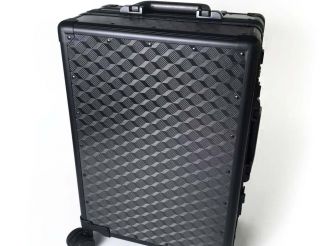
Hard-shell luggage was one of the first mass consumer categories to adopt carbon fiber panels, largely because the value proposition is easy to explain. Shells are built as thin laminates, often bonded to a foam or honeycomb core, which keeps the case rigid while reducing weight.
Design priorities in travel goods
Impact resistance at corners, scratch behavior on the outer surface, and the stiffness of handles and telescopic tubes are the usual engineering focus. Many premium cases combine a carbon fiber outer skin with a polycarbonate or composite structural layer, which balances cost against the weight and stiffness target.
2.2 Eyewear Frames
Spectacle frames are a natural fit. Temples and front sections made from carbon fiber composite stay thin, resist bending, and shed weight from the nose and ears.
Why the frame category moved so fast
Eyewear is worn for hours, so a few grams matter more here than in most categories. Carbon fiber also survives the repeated flexing of putting glasses on and taking them off, which is exactly the cycle that breaks thin metal temples over time.
The material also allows a very slim profile that metal cannot match without becoming heavy. Many frames use a carbon core with an outer layer of acetate or rubber for comfort, so the fiber does the structural work while the other material handles contact with skin.
2.3 Watches and Wearable Accessories
Watch cases, bezels, and bracelets are a growing use. Forged carbon and layered carbon constructions give each piece a slightly different surface pattern, which the industry treats as a feature rather than a defect.
The material also handles the thermal and corrosion requirements of a product worn against the skin daily. Carbon fiber does not react with sweat the way some base metals do, and it stays comfortable across a wide temperature range.
2.4 Everyday Carry and Tools
Knife scales, multi-tool handles, pens, and wallets have adopted carbon fiber for the same reasons as larger products: stiffness, low weight, and a surface that resists wear. Small parts also benefit from the material's ability to be molded into complex shapes with defined ribs and bosses.
2.5 Mobile Devices and Accessories
Phone cases, laptop shells, tablet covers, and accessory stands use carbon fiber plate and sheet material. Laptop manufacturers have used carbon fiber reinforced panels for years to cut chassis weight while keeping the deck stiff under typing load.
In accessories the material is often combined with aramid fiber fabric for a hybrid cosmetic effect, since aramid brings its own distinctive surface while adding toughness.
2.6 Home, Audio, and Lifestyle Goods
Speakers, headphones, furniture details, and premium kitchen tools all appear in the carbon catalog. Where the product involves vibration, the material's damping properties and stiffness can measurably improve sound and feel.
3. Choosing the Right Material Form
The consumer segment uses most of the standard carbon fiber product family, and matching the form to the process is where cost is won or lost.
3.1 Fiber and Fabric Forms
Laminated visible parts usually start from woven carbon fabric, either twill or plain weave, or from spread tow fabric when a flatter, more uniform surface is wanted. Unidirectional fabric is used where stiffness must follow one axis, such as a tube or a beam.
Chopped carbon fiber and milled fiber are used in injection-molded and compression-molded parts, where complex geometry matters more than maximum strength. These grades bring carbon performance to high-volume consumer products at a far lower price point.
3.2 Prepreg and Plates
Carbon fiber prepreg gives consistent resin content and clean surfaces, which is why it dominates premium visible parts and small structural components. Carbon fiber plates and sheets, often produced by pressing multiple prepreg layers, are a convenient starting point for accessories that will be cut and machined.
3.3 Tubes and Profiles
Carbon fiber tubes and pultruded profiles suit handles, tripods, tent poles, walking sticks, and similar products. The manufacturing route is efficient, and the resulting parts combine low weight with predictable stiffness.
3.4 Hybrid and Supporting Fibers
Not every consumer product needs a pure carbon layup. Aramid fiber adds impact tolerance and a different visual character, which is why carbon and aramid hybrid fabric is popular in cases and protective goods.
Pre-oxidized fiber fabric and felt play a different role, bringing flame resistance and thermal insulation to products where heat or fire safety is part of the requirement. Hybrid construction lets a brand advertise carbon where it counts and use supporting fibers where the engineering demands it.
4. Manufacturing Routes and Cost Reality
Cost is the honest conversation in consumer products. Carbon fiber carries a material premium, and the process chosen decides whether a product can sell at its target price.
4.1 Common Processes
Compression molding, resin transfer molding, and autoclave or press curing of prepreg cover most structural consumer parts. For higher volumes, molding with chopped or milled carbon compounds brings cycle times down and tooling cost within reach.
Pultrusion and filament winding handle tubes and profiles efficiently. Machining from carbon fiber plate suits small-batch and design-driven products where tooling investment would be hard to justify.
4.2 Where the Cost Sits
Labor, tooling, and finishing usually matter as much as raw fiber price. A visible-weave part needs clean layup and careful clearcoat to look right, and cosmetic rejects can erase the margin on a production run.
Smart brands decide early whether carbon is structural, decorative, or both. If it is decorative, a thinner laminate over a structural substrate is often the economical answer. If it is structural, the layup and process should be specified with the load case in mind rather than copied from a generic template.
4.3 Quality and Consistency
Consumers may not read a test report, but they notice inconsistency. Resin content, fiber alignment, void content, and surface finish all need to be controlled from batch to batch, especially when the material is visible.
Established suppliers work to defined laminate schedules and inspect incoming fabric and prepreg for weight, weave, and handling quality. That discipline is what keeps a premium product premium after the tenth production run.
5. A Buyer and Brand Checklist
Before committing to a carbon fiber consumer product, a brand should be able to answer the following questions.
5.1 Technical Questions
Questions the design team should answer first
5.2 Commercial Questions
6. Where the Segment Is Heading
Several trends are shaping the next few years of carbon fiber consumer products.
6.1 Recycled and Lower-Cost Grades
Recycled carbon fiber and non-aerospace grade tow are opening categories that could not previously justify the material, particularly in molded parts where appearance is secondary. This lowers the entry price and widens the addressable market.
6.2 Forged and Textured Surfaces
Forged carbon and intentionally varied layered surfaces have become a design language of their own. Expect more brands to treat surface pattern as a product feature rather than something to hide under paint.
6.3 Hybrid Constructions
Combining carbon fiber with aramid, glass, or natural fibers lets designers tune cost, impact behavior, and appearance without abandoning the carbon story. Hybrid fabric is increasingly the default in protective and travel goods.
6.4 Sustainability Pressure
Buyers increasingly ask about resin systems, recyclability, and supply chain transparency. Suppliers who can answer those questions clearly will have an advantage in tenders and shelf decisions alike.
Consumer products may not carry the engineering prestige of an aircraft wing, but they are where most people first meet carbon fiber. That makes the segment commercially important and technically interesting in equal measure. Brands that get the material form, the process, and the finish aligned end up with a product that feels as good as it looks, which is ultimately what sells the next one.
Tanchain supplies carbon fiber filament, chopped fiber, carbon fabric, prepreg, aramid fiber, pre-oxidized fiber, and hybrid fabric for consumer product programs, from visible-weave laminates to molded parts. Explore our product range or contact our team to discuss the right specification for your next lightweight product.