


Carbon fiber in agricultural machinery is one of the clearest examples of a high-performance material finding an unexpected home. Farmers, agronomists and equipment dealers rarely talk about composite laminates, and yet the working conditions on a modern farm are almost deliberately hostile to metal: fertiliser salts, slurry acids, abrasive soil, long field hours and a constant demand to cover more hectares with less fuel. A carbon fiber boom, a carbon fiber sprayer chassis or a carbon fiber grain chute does not just look modern — it responds directly to problems that farmers have lived with for decades. This guide walks through the agricultural sector in detail, part by part, to show where carbon fiber agricultural equipment already works, which material form suits each component, and how the economics of carbon fiber farm machinery actually add up.
1. The Agricultural Equipment Industry and Its Material Problem
Agriculture is a low-margin, high-capex business. A single self-propelled sprayer or combine can cost as much as a small house, and it must then earn its keep across a narrow seasonal window. Any technology that reduces fuel burn, increases working width, shortens field time or extends service life has an immediate financial value to the owner. This is precisely the logic that has pulled carbon fiber into the sector.
2. Why Carbon Fiber Suits Farm Machinery So Well
Carbon fiber reinforced polymer (CFRP) is not chosen because it is fashionable. It is chosen because four of its properties map directly onto four chronic agricultural problems.
2.1 Weight Reduction Under a Legal Road Limit
Agricultural machinery spends much of its life on public roads, where axle loads, gross vehicle weight and transport width are all regulated. Every kilogram saved in the structure is a kilogram that can be spent on payload, water, seed or fertiliser instead. Because a CFRP component can match the stiffness of steel at roughly one quarter of its density, carbon fiber weight reduction in trailers, booms and tanks translates directly into either a larger legal payload or a lighter, less compacting machine.
2.2 Corrosion Resistance in a Chemical Environment
Farms are chemical factories in the open air. Liquid nitrogen, urea, ammonium nitrate, phosphoric acid, slurry, silage effluent and road salt all attack unprotected steel, and even galvanised or painted steel eventually fails. A polymer matrix composite simply does not rust, and with an appropriate gelcoat or resin system it withstands fertiliser salts for years with almost no maintenance. This is one of the strongest reasons carbon fiber corrosion resistance matters more in agriculture than in many industrial sectors.
2.3 Fatigue Life and Vibration Damping
A sprayer boom is a cantilever beam that is being cycled thousands of times per season by ruts, headlands and gusts. Metals accumulate fatigue damage at stress concentrations and eventually crack at welded joints. CFRP is far more tolerant of cyclic loading, and its internal damping converts vibration into a small amount of heat rather than into a propagating crack. The result is a boom that stays true, holds its nozzle height and needs fewer seasonal repairs.
2.4 Soil Compaction and Machine Efficiency
Soil compaction is a yield problem as much as a mechanical one: compacted subsoil restricts root growth and reduces water infiltration for years. Lighter machines reduce axle loads and ground pressure, which protects the soil structure, and lighter implements also demand less hydraulic power and less tractor ballast. The same machine can then use a smaller tractor, burn less diesel and finish the field faster.
3. Carbon Fiber Applications Across the Agricultural Sector
The agricultural applications of carbon fiber are broader than most buyers expect. They fall into seven recognisable groups.
3.1 Sprayer Booms and Boom Sections
The self-propelled and trailed sprayer is the flagship case for composite lightweighting in agriculture. Working widths of 36 to 48 metres are now common, and a steel or aluminium boom of that span is either very heavy or very flexible. A carbon fiber sprayer boom, built from carbon fiber tubes and box sections with local carbon fiber plate reinforcement at the folding joints, delivers a stiffer boom at a fraction of the mass. Trapezoidal and triangular boom structures are of particular interest here, because the CFRP architecture can be tailored so that the boom stays level and tip deflection remains small as the machine travels across slopes and ruts.
A lighter boom also means the suspension and the folding mechanism can be smaller, so the savings compound through the whole machine rather than sitting in one component. For contractors covering thousands of hectares per season, reduced pass-to-pass variation in nozzle height translates into more accurate application and less chemical waste.
3.2 Sprayer Chassis and Tank Supports
Alongside the boom, the structural frame that carries the spray tank is a natural composite application. Carbon fiber tube and pultruded structural profiles form a stiff, corrosion-proof skeleton that never needs repainting and does not care about spilled agrochemicals. Because it does not rust, the frame does not lose section thickness over the machine's life, so stiffness and alignment are retained rather than gradually degrading.
3.3 Seeders, Planters and Row-Crop Implements
Precision planters must maintain a constant, small downforce on each row unit so that seed depth stays uniform at speed. Every kilogram of tool-bar and frame mass has to be supported and controlled, so removing mass from the structural members makes depth control more accurate and the whole machine easier to lift, fold and transport. Carbon fiber tool bars and carbon fiber frame members reduce the moving mass, which lets the depth-control system react faster and keeps singulation and spacing quality high even at higher working speeds.
3.4 Grain Handling and Harvesting Components
Header frames, reel components and chute surfaces all benefit from the combination of low mass and abrasion tolerance. Grain and forage flow is extremely abrasive, and while a carbon fiber surface is not a wear plate, thin replaceable liners over a composite substrate are common practice. The structural benefit is that the substrate carries the load, does not corrode in damp crop, and keeps the header light enough to float over uneven ground without digging in.
3.5 Fertiliser Spreaders and Slurry Equipment
Disc spreaders, spinner assemblies and slurry application hardware operate in the most chemically aggressive part of the farm. Urea and ammonium nitrate are hygroscopic and corrosive, and slurry is both abrasive and acidic. CFRP housings, vanes and structural members resist this environment without the coating maintenance that steel demands. Pre-oxidized fiber components can also be added as a thermally stable, non-conductive barrier where a spreader or pump runs against a heat source.
3.6 Harvesting Efficiency and Smart Farming Platforms
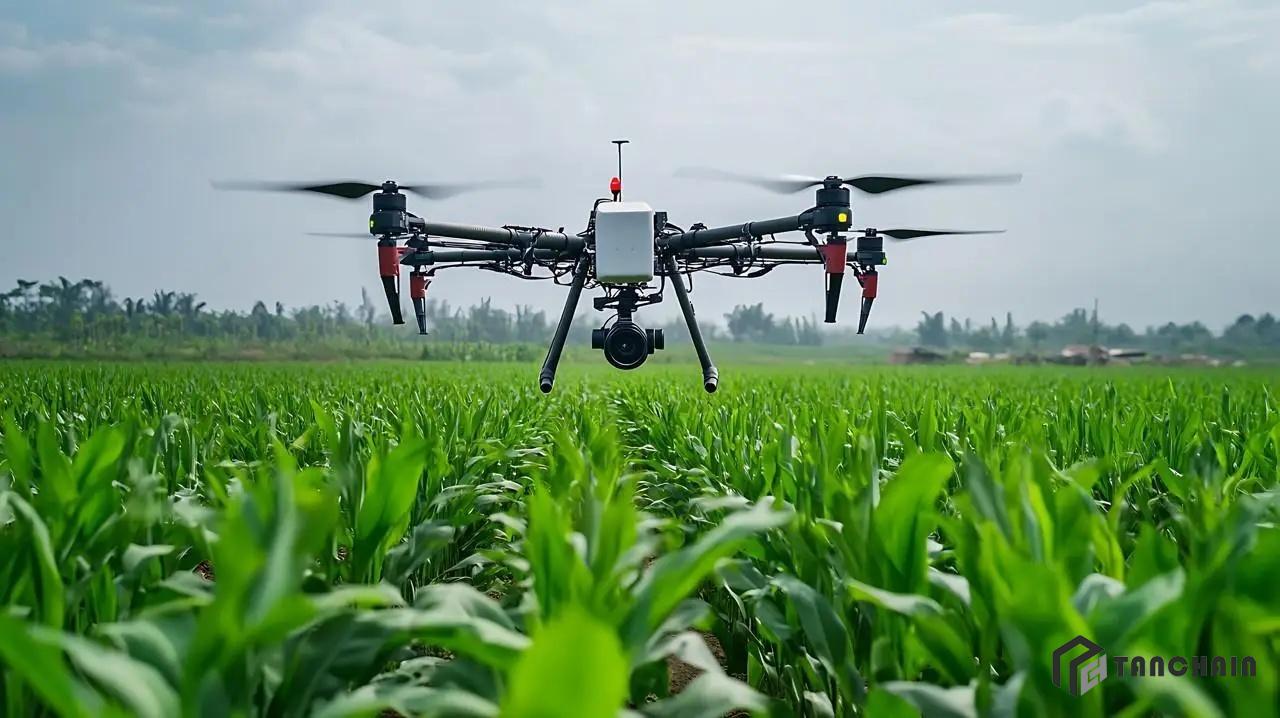
Modern agriculture is increasingly sensor-driven. Yield monitors, camera arrays, lidar scanners and variable-rate nozzles all hang off a boom, a mast or a cab roof, and every gram of mounting structure has to be carried all season. Lightweight carbon fiber tubes and machined carbon fiber plate are ideal mounting solutions for these electronics packages because they hold alignment (sensors must not drift out of calibration as a steel mount flexes), do not corrode, and can be shaped to put the payload exactly where it is needed. The same logic applies to drone-based crop scouting platforms, which depend on carbon fiber frames for endurance.
3.7 Livestock Housing, Handling Systems and Infrastructure
In livestock buildings, carbon fiber and hybrid composite structural elements suit chutes, gates, ventilation housings and robotics rails, where the environment is permanently humid, ammoniated and washed down with disinfectant. Components that would rot, rust or corrode survive indefinitely. Aramid fibre blends are useful here because they add impact toughness at the points where animals and machinery make contact.
4. Material Forms: Matching the Fiber to the Component
Choosing carbon fiber for a farm implement is not a single decision. The right form depends on the load path, the production volume and the shape required.
4.1 Carbon Fiber Tubes and Pultruded Profiles
Continuous carbon fiber tubes and pultruded profiles are the workhorses of agricultural frames. They arrive as straight stock with a constant, certified cross-section, and they can be cut, drilled, bonded and bolted in a normal fabrication shop without autoclave equipment. Booms, tool bars, linkage arms, sensor masts and trailer beams are all typically built from these forms.
4.2 Carbon Fiber Plate
Machined carbon fiber plate serves the joints, brackets, hinge plates, gussets and reinforcement pads where loads are concentrated. Because it holds tolerance and does not deform in damp conditions, it is the preferred choice for load-introducing hardware that must keep bolts from working loose.
4.3 Carbon Fiber Prepreg and Fabric
Where a component has a compound curvature or must be moulded to a specific shape — a tank shell, a shroud, an air-duct, a custom cover — carbon fiber prepreg and carbon fiber fabric are laid up over a mould and cured. Prepreg gives the highest and most consistent fiber volume fraction; dry fabric with resin infusion is more economical for larger, lower-volume parts.
4.4 Carbon Fiber Short Fiber and Compounds
Chopped and milled carbon fiber is compounded into thermoplastic pellets for injection moulding. This route produces complex, high-volume parts such as clips, housings, handles, brackets and covers at low unit cost, with a useful uplift in stiffness, creep resistance and dimensional stability compared with unreinforced plastic.
4.5 Hybrid Systems with Aramid and Pre-Oxidized Fiber
Few agricultural parts are made from carbon fiber alone. Aramid fibre fabric adds impact and abrasion resistance at contact points and along edges. Pre-oxidized fiber felt and fabric provide flame-resistant, thermally stable, electrically non-conductive insulation around engines, exhausts, heaters and battery compartments. Blending these fibre families lets a designer place toughness, insulation and stiffness exactly where each is needed.
5. Manufacturing Routes and Cost Reality
Cost is the question every farm equipment buyer asks first, and the honest answer is that carbon fiber is not competing with mild steel on price per kilogram. It competes on total cost of ownership.
5.1 Pultrusion and Pull-Winding for Constant Sections
Pultrusion draws continuous fibre through a resin bath and a heated die to produce a constant cross-section at high line speed. It is the most economical way to make carbon fiber agricultural profiles such as tubes, rods and structural shapes, and it is why these forms are now stocked items rather than bespoke projects.
5.2 Resin Infusion and Prepreg Layup for Large Shaped Parts
For booms, tank shells and shrouds, vacuum infusion or prepreg layup over a mould gives the best balance of shape freedom, fibre alignment and cost at low to medium volume. Tooling is a one-off investment that is recovered across the production run.
5.3 Filament Winding for Tanks and Cylinders
Filament winding places continuous carbon fiber under tension in the exact helical or hoop pattern the pressure and bending loads require. It is the standard route for tanks, cylinders, rollers and shafts, and it produces very high fibre volume fractions with low labour content per part.
5.4 Compression Moulding and Injection Moulding for Series Parts
Once volumes rise into the thousands, compression moulding of carbon fiber sheet moulding compound, or injection moulding of short-fiber compounds, brings cycle times down to minutes and makes carbon fiber viable for brackets, covers and small components that no one would previously have considered composite candidates.
5.5 How the Cost Case Is Built
The economic argument rests on four measurable items rather than on material price alone. The first is weight reduction and the resulting capacity, fuel and soil value. The second is corrosion elimination and the maintenance, painting and replacement costs it removes. The third is longer fatigue life on cyclically loaded members such as booms. The fourth is reduced downtime during a harvest or spraying window, when the cost of a stopped machine is measured in hectares. Where all four apply, a carbon fiber component can be cheaper over its service life than the steel or aluminium part it replaces, even at a substantially higher purchase price.
6. Sourcing Checklist for Composite Farm Equipment
Buyers of carbon fiber agricultural components should ask a small number of precise questions before committing.
Fibre architecture: which fibre orientation carries the primary load, and has the laminate been designed for the real load path rather than copied from a steel part?
Resin and finish: which resin system and surface treatment resist the specific chemicals and UV exposure on this farm?
Operating temperature: does the component see engine, exhaust or radiant heat, and is a pre-oxidized fiber or ceramic barrier specified where it does?
Impact and edge protection: are aramid or hybrid plies placed where stones, stubble or livestock will strike the part?
Galvanic isolation: where CFRP meets aluminium or steel, are insulating sleeves, shims or bushings specified so that dissimilar metals in a wet environment do not corrode?
Repair strategy: can a field or workshop repair be carried out with a bonded patch, or does the part have to be returned?
Documentation: are layup schedule, fibre content, and mechanical test data traceable to the delivered part?
7. Trends Reshaping the Sector
Several trends are pushing carbon fiber further into mainstream agriculture. Precision application is one: as chemical use is regulated more tightly and input costs rise, the value of a stable, level boom and accurate nozzle height grows, and composite booms deliver both. Automation is another: autonomous and semi-autonomous field machines have no operator to compensate for a heavy, awkward implement, so low mass becomes a functional requirement rather than a nice-to-have. Sustainability pressure is a third: lighter machines mean lower fuel consumption and less soil compaction, both of which are increasingly reported by growers and contractors. Finally, electrification is spreading from small utility vehicles into orchard and specialty crop platforms, where every kilogram saved extends the working range in exactly the same way it does in a road vehicle. In each case the enabling technology is a material that is stiff, light, corrosion-proof and dimensionally stable.
Shanghai Tanchain New Material Technology supplies the complete fiber stack behind these machines — carbon fiber precursor and filament, carbon fiber staple, fabric, prepreg, plate, tube, pultruded profiles and finished composite parts, alongside aramid filament, aramid fabric and the full pre-oxidized fiber range of filament, staple, yarn, felt and fabric. Whether the project is a first composite boom prototype or a production programme for planter frames, our team can advise on the material form, fiber architecture and resin system that fit the duty cycle. Browse our carbon fiber product range or send an enquiry for a specification discussion on your next agricultural machinery programme.